
When does an aircon need a gas top-up?
An aircon only needs a gas top-up when some of its gas has escaped. The gas runs in a sealed loop, so it is never used up. A slight drop found at a routine service can be topped up and watched; if it drops again by the next visit, the leak needs finding before more gas goes in. Key takeaways
- Gas is not used up: the aircon's gas runs in a sealed loop, so low gas always means a leak somewhere.
- A first slight drop can be watched: we top up to the right level and measure again at the next visit.
- A second drop needs a leak check: topping up again and again only refills a leak.
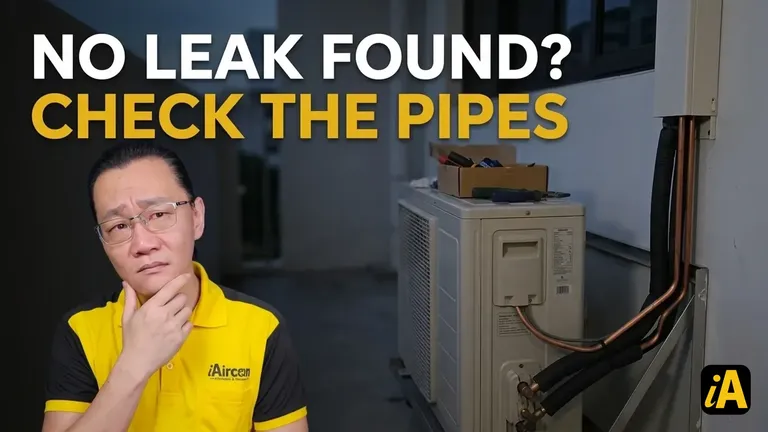
- Regular visits catch it early: a quarterly service found a slight drop before the room got warm. In the video above, our team does a quarterly visit at an Ashi Foot Reflexology outlet in Ang Mo Kio, on Mitsubishi Electric Starmex aircons. The coils were still clean, but the blower fans were dirty, so they were PowerJet-washed. At one outdoor unit the gas was slightly low, so we topped up R410A.
How to tell if your aircon needs a gas top-up
- Rule out dirt first. Dirty filters, a dirty coil or a dirty blower fan cut the cooling too, and are easy to mistake for low gas. If the aircon has not been serviced for months, start with premium servicing.
- Look for the low-gas signs. Cooling that faded slowly over weeks, ice or frost on the copper pipes or the indoor coil, and an outdoor unit that runs without a break while the room stays warm. We explain each one in the signs of an aircon gas leak.
- Have the gas measured, not guessed. At every servicing we check the cooling first. If it looks abnormal, we tell you what we see and ask before checking deeper, with the S$165 cost explained before we start. Our gas check and top-up measures the gas and adds only what is missing. If step 2 sounds like your aircon, book a gas check.
- If it is the first slight drop, top up to the right level and have it measured again at the next service, as we did in the video.
- If it has dropped again, stop topping up. The leak has to be found first, with an infrared leak check that covers the pipes, the joints and both units. If the cooling is weak but none of the gas signs fit, our guide to why an aircon is not cold covers the other causes.
The real case: a quarterly visit in Ang Mo Kio
Ashi Foot Reflexology is our biggest client. Their outlet on Ang Mo Kio Avenue 10 runs its aircons from 9am to 11pm every day, more than 12 hours a day, so we look after it on a quarterly maintenance contract. This visit went like this:
Part | What we found | What we did |
|---|---|---|
Evaporator coil | Still clean | No chemical wash needed; Viper coil cleaner sprayed on, part of Ashi's maintenance contract, to help keep it clear and prevent water leaks |
Blower fan | Dirty | PowerJet-washed, as at every service |
Gas at the outdoor unit | Slightly low on one outdoor unit | Topped up with R410A, the gas on the nameplate |
| Next visit | | Gas measured again; a leak check if it has dropped |
Why the coil was clean but the blower fan was not
A clean coil does not mean a clean aircon. The blower fan sits behind the evaporator coil, stays damp while the aircon runs, and collects dust and black mould between its blades. That is why the fan is washed at every visit, even when the coil needs nothing more than a light treatment. The same dirt washes down into the drain pan, where microbes grow into a jelly-like slime. Over months without proper servicing, that slime clogs the drain line, the water stops flowing out and backs up into the aircon, and it starts to leak. A dirty air filter alone does not cause water leaks, but a dirty blower fan can cause weaker cooling and a water leak at the same time.
Why we topped up instead of hunting for the leak straight away
The drop was slight, and it was the first we had seen on that outdoor unit. Topping up brought the gas back to the right level before the cooling faded, and the drop is now on record. At the next quarterly visit the gas is measured again. If it has held, nothing more is needed for now. If it has dropped again, there is a slow leak, and finding it is cheaper than paying for gas every few months.
Which gas goes in
A top-up always uses the gas printed on the outdoor unit's nameplate. This Starmex system runs on R410A; most newer inverter aircons in Singapore use R32; very old units use R22. Gases are never mixed.
What it costs
Job | Price | What is included |
|---|---|---|
Gas Check + Top-up | S$165 | Gas measured, topped up to the right level and measured again; if the gas is fine, it goes towards the service that fixes the cooling |
Premium servicing | S$80 for 1 unit | Blower fan and drain pan PowerJet-washed, coil cleaned, drain pipe cleared, cooling checked |
| Infrared leak check | S$580 for 1 to 3 units, S$880 for 4 to 5 | Leak found with infrared and ultrasonic detectors, gas top-up included | Every service carries a 90-day warranty.
When to call a technician
Book a gas check if the cooling has faded over a few weeks, you see ice on the copper pipes, or the aircon needed gas before and is getting warm again. In Ang Mo Kio and across Singapore, you can book online in under a minute, or ask Luna on WhatsApp at any hour.
Frequently asked questions
Does an aircon need a gas top-up every year?
No. The gas runs in a sealed loop and is never used up, so a healthy aircon keeps the same gas for its whole life. An aircon that needs gas every year has a leak somewhere.
Is it safe to keep topping up instead of fixing the leak?
It keeps the aircon cooling for a while, but the gas keeps escaping and every top-up is paid for again. Running short of gas also makes the compressor work harder. Once the gas has dropped a second time, finding the leak is the cheaper path.
Will a gas top-up make my aircon colder?
Only if the gas was low. Adding gas to an aircon that already has the right amount does not cool better; too much gas makes it work worse. That is why we measure first and add only what is missing.
How do I know which gas my aircon uses?
It is printed on the nameplate of the outdoor unit. Most newer inverter aircons use R32, many older ones R410A, and very old units R22. A top-up always uses the gas on the nameplate, never a mix.
What if the technician finds my gas is fine?
Then the cooling problem is something else, often dirt on the coil or blower fan. With us, the S$165 paid for the gas check goes towards the service that fixes the cooling.

Eric Lim, aka Uncle EricFounder of iAircon.Repair, now in its 10th year servicing aircons in Singapore. Some of our jobs are filmed, and you can watch the work on YouTube.