
What are the most common aircon outdoor unit problems in Singapore?
The most common outdoor unit problems are a dirty condenser coil and poor airflow on a cramped aircon ledge, followed by corrosion, fan motor or capacitor faults, refrigerant leaks at flare joints, and PCB failures. Servicing fixes the first two by cleaning the coil and clearing airflow; the rest need a repair, often spotted during servicing.
Key takeaways
- A dirty condenser coil traps heat: the compressor runs longer and hotter, and rooms feel less cold.
- One outdoor unit can serve every room: on a System 2, 3 or 4 multi-split, an outdoor fault affects the whole home.
- Harsh chemicals cause leaks later: strong alkaline cleaners can strip the coil's anti-corrosion layer and eat the aluminium.
- Low gas means a leak: the refrigerant circuit is sealed, so the leak has to be found and repaired, not just topped up.
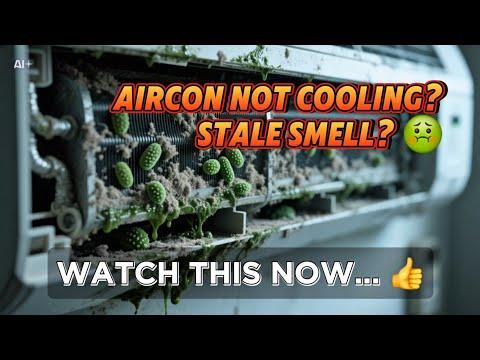
In the video above, Uncle Eric's team PowerJet-cleans two outdoor condensing units during an aircon servicing job, showing each step from the surrounding walls to the heat exchanger.
How can I tell if the outdoor unit is the problem?
You can do these checks from inside, through a window. Do not climb onto the aircon ledge.
- Is the outdoor fan spinning while the aircon cools? If it is still and you hear a buzz, switch off: it is likely a capacitor, contactor or fan motor fault, and the compressor overheats without the fan. If it spins, go on.
- Is the ledge clear? Pots, boxes, laundry or a tight louvre screen block airflow, so hot air recirculates. Clear what you safely can.
- Does the condenser coil look grey or matted? Dust on the fins traps heat. If the coil is visibly dirty and it has been a while since the last service, it is due for cleaning: book your next service.
- Are all rooms less cold at once? On a multi-split, that points to the outdoor unit or low refrigerant rather than one indoor unit. See signs of an aircon gas leak.
- Does the breaker trip when the aircon starts? That points to an electrical fault in the compressor, fan motor or wiring. Leave it off and call a technician.
- Is there a new noise from outside? Rattling, buzzing or grinding each mean something different: see what aircon noises mean.
What does the outdoor unit do?
The outdoor unit holds the compressor, the condenser coil (heat exchanger) and a fan. The indoor unit absorbs heat from your room into the refrigerant. The compressor pumps that refrigerant outside, and the condenser coil releases the heat into the air, with the fan pushing air across it. For the full cycle, see how an aircon works and where it goes wrong.
If the outdoor unit cannot reject heat efficiently, rooms feel less cold, the compressor runs longer and hotter, and electricity use goes up.
Which outdoor unit faults do we see most?
Dirty or clogged condenser coil
Dust, soot and grime from traffic and construction settle on the fins and act like a blanket. This is the most common outdoor unit problem and the easiest to fix with proper cleaning.
Poor ventilation on the aircon ledge
Many HDB flats and condos put outdoor units on narrow ledges, sometimes stacked, behind screens or with items stored around them. If the hot air cannot escape, the unit pulls it straight back in.
Corrosion
Rain, humidity and dirty air slowly corrode the coil and casing. Corrosion on the coil can eventually cause tiny refrigerant leaks, and harsh cleaning chemicals speed it up.
Fan motor or capacitor faults
If the outdoor fan stops while the compressor runs, heat builds up quickly and the system may cut out. A failed capacitor or a worn fan motor bearing is a common cause.
Refrigerant leaks
Leaks often happen at the flare joints and service valves on the outdoor unit, or in a corroded coil. Most current inverter units use R32; many older ones use R410A, an HFC; very old units use R22, which has been phased out. Each system needs its own refrigerant, and topping up without finding the leak only delays the next breakdown.
Outdoor PCB faults
Outdoor units have their own control board, which can fail with age, power surges or moisture, leaving the outdoor unit dead. Our Mitsubishi Starmex outdoor PCB replacement case study shows one of these repairs.
How should an outdoor unit be cleaned?
This is the approach shown in the video:
- Wash away the surrounding dust and dirt first, so it does not blow back onto the coil.
- Clean the heat exchanger with PowerJet to push dirt out from between the fins.
- Avoid harsh chemicals. Highly concentrated alkaline cleaners can strip the coil's anti-corrosion layer.
- Use only a cleaner certified non-corrosive and aluminium-safe, if a chemical is needed at all. We use Viper's.
- Clean the walls around the unit, which slows how quickly dust returns to the heat exchanger.
- Keep the work area dust-free for a more effective result.
Why can harsh coil chemicals cause gas leaks?
Condenser coils are thin aluminium fins around copper tubes. Strong alkaline chemicals react with aluminium, and acid cleaners can attack it too. Any residue left behind keeps eating the metal, and over months that can lead to refrigerant leaks and expensive repairs. A certified non-corrosive cleaner and thorough rinsing avoid that risk. Watch: when to clean the outdoor condensing unit.
What can servicing fix, and what needs a repair?
Problem | Fixed by servicing? | What is needed instead |
|---|---|---|
Dirty condenser coil | Yes, as an outdoor wash (extra cost) | Coil cleaning with PowerJet |
Blocked airflow on the ledge | Partly | Clearing items around the unit |
Loose panels, rattles | Usually | Tightening and securing |
Faulty fan motor or capacitor | No | Repair or part replacement |
Refrigerant leak | No | Leak search, repair, evacuation and recharge |
Outdoor PCB fault | No | Diagnosis and PCB replacement |
Regular premium servicing keeps the coil clean and gives a technician the chance to spot the other faults early.
What it costs
Job | Price | What drives it |
|---|---|---|
Premium servicing (outdoor unit checked) | S$80 for 1 unit | Number of indoor units, System type |
Outdoor unit PowerJet cleaning | Quoted on site before washing | Ledge access, unit size |
Outdoor fan motor or capacitor replacement | Quoted after the S$150 diagnosis | Brand, model, part availability |
Gas leak check and repair | Leak check S$580 (1 to 3 units) or S$880 (4 to 5), repair quoted after | Leak location, refrigerant type |
Outdoor PCB replacement | Quoted after the S$150 diagnosis | Brand and model |
When to call a technician
Call us if the outdoor fan is not spinning, the breaker keeps tripping, there is a new loud noise from outside, there is frost on the pipes at the outdoor unit, or the rooms are not as cold as they used to be. Our technicians diagnose and repair outdoor unit faults, with a repair warranty from 180 days (servicing carries 90 days).
You can book online in under a minute, or chat with Luna, our AI assistant, on WhatsApp any time.
Frequently asked questions
Should my aircon outdoor unit be producing water?
In normal cooling, the water you see comes from the indoor unit's drain, not the outdoor unit. Water around the outdoor unit is usually rain, a drain pipe that empties onto the ledge, or a neighbour's drain above. If water seems to come from inside the outdoor unit itself, ask a technician to check.
Can I hose down the outdoor unit myself?
It is not recommended. Most outdoor units sit on an aircon ledge that is unsafe to stand on, the condenser coil fins bend easily, and spraying water at electrical parts is risky. Outdoor unit cleaning is best left to a technician with the right access and equipment.
Does a System 3 or System 4 multi-split need more outdoor unit care?
One outdoor unit serves every room on a multi-split system, so it works harder and a fault there affects all the rooms at once. Keeping its condenser coil clean and its ledge clear matters more, not less.
Why does my aircon trip the circuit breaker?
Tripping can come from an electrical fault in the outdoor unit, such as a failing compressor, fan motor or damaged wiring, or from water reaching electrical parts. It needs a technician to test the parts. Do not keep resetting the breaker.
Does the outdoor unit ever freeze up?
The condenser coil in the outdoor unit releases heat, so it does not ice over in cooling mode. Ice usually forms on the indoor evaporator coil or its pipes, from low airflow or low refrigerant. Frost on the pipes at the outdoor unit's service valves is a sign of low refrigerant, which means a leak.

Eric Lim, aka Uncle EricFounder of iAircon.Repair, now in its 10th year servicing aircons in Singapore. Every job is filmed, so you can watch the work on YouTube.