
Is a chemical overhaul safe for my aircon?
A chemical overhaul is safe when done properly, but it is a last resort for an extremely soiled aircon. Taking the unit down opens the refrigerant pipes, which raises the risk of gas leaks, so the job must end with a leak check and a thorough vacuum evacuation. Skipping them invites compressor damage.
Key takeaways
- An overhaul is a last resort: it is meant for an extremely soiled aircon, because opening the pipes raises the risk of gas leaks.
- Evacuation is not optional: air and moisture left in the pipes corrode the system from the inside.
- Multi-split systems share the risk: on a System 2, 3 or 4, one sloppy overhaul can affect every indoor unit.
- Dry before the gas goes back: the system must be shown to be dry and sealed before the refrigerant is released.
In the video above, Uncle Eric shows a coil being washed with a flat high-pressure jet, top down, and then the system being evacuated and dried out before the gas goes back in.
Why is a chemical overhaul a last resort?
An overhaul is for an extremely soiled aircon, where cleaning on the wall cannot reach the dirt. It is the deepest clean you can give an aircon, but it also involves the most handling, and opening the pipes raises the risk of gas leaks. That is why we recommend it only as a last resort. The unit comes off the wall, the pipes are opened at the flare joints, the coil is separated from the body, and every joint has to be made good again afterwards.
For most homes, regular servicing with a PowerJet wash keeps the coil clean enough that an overhaul is not needed for a long time. If you are still deciding, see chemical wash vs chemical overhaul.
What can go wrong with a sloppy overhaul?
Mistake | What happens | How you would notice |
|---|---|---|
Flare joints not remade or tightened properly | Refrigerant slowly escapes | Cooling fades over the following weeks; oily marks at the joints |
No vacuum evacuation | Air and moisture stay inside and corrode the system | Weaker cooling, then compressor or expansion valve faults months later |
Moisture let into a shared multi-split system | Units nobody worked on are affected too | Several rooms lose cooling, not just the one overhauled |
Poor jetting | Coil fins flattened | Weak airflow even though the coil looks clean |
Chemical not rinsed out | Residue keeps corroding the fins | A chemical smell, then early coil wear |
The video is blunt about the second row. Without evacuation, the air and moisture that entered the pipes can corrode the entire system, with irreversible damage to the compressor, the expansion valve and the pipework itself. That means repeat callbacks, costly repairs or even replacing the whole system.
On a multi-split (System 2, 3 or 4, common in HDB flats and condos), several indoor units share one outdoor unit and compressor. Moisture let in while overhauling one bedroom unit can damage the whole system. The same problem with rinsing shows up in cheap chemical wash deals.
How do we keep an overhaul safe?
- Confirm it is needed. We open the unit first. If servicing or a wash will do the job, we say so.
- Secure the refrigerant in the outdoor unit before any pipe is disconnected.
- Strip the indoor unit and separate the coil, blower fan, drain pan and casing.
- Clean the coil with PowerJet. As the video shows, the jet spray must be fully flattened to clean through the fins, and the coil is washed from the top down so gravity carries the dirt out.
- Clean every other part inside out, then reassemble and remount the unit.
- Leak check. We test the joints for leaks.
- Pump out the air and moisture with a vacuum pump, and check that the system stays dry and sealed before going on.
- Release the refrigerant, check the gas and the cooling, and top up only if needed.
If your unit has reached step 1 and really is extremely soiled, our chemical overhaul service follows every one of these steps, and includes a free gas check and top-up (worth S$165) and deep evacuation (worth S$395) at no extra cost. Any flare joints we remake during the overhaul are under warranty. You can watch: chemical overhaul with dismantle cleaning and full evacuation, and read more in why vacuum evacuation matters.
Is the coil chemical itself safe?
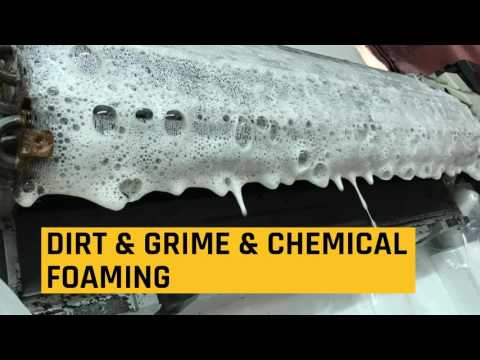
Yes, when it is used correctly. Coil chemicals, whether alkaline or acid-based, are strong, so they have to be diluted and then rinsed out completely, because any left in the fins keeps eating at the thin metal. We use alkaline coil cleaners only in extreme conditions. A thorough high-pressure rinse is what makes the chemical step safe, and the reason we use PowerJet on every overhaul.
What should I ask before booking an overhaul?
- Will you do a vacuum evacuation afterwards, and how do you check the system is dry?
- Will you leak-check the joints before releasing the gas?
- If my aircon is a multi-split system, how do you protect the other units?
- Do you check the gas after the job?
- What warranty do I get?
If a company cannot answer the first two clearly, think twice. Every iAircon service comes with a 90-day warranty.
When to call a technician
Signs of a problem after an overhaul elsewhere:
- Cooling is weaker than before the overhaul, or fades over a few weeks.
- Ice forms on the pipes or the indoor unit.
- You see oily marks at the pipe joints or hear hissing.
- The outdoor unit sounds louder or rougher than before.
If gas may be the issue, our gas top-up service measures the charge first; finding a leak is our separate infrared leak check. Book online in under a minute with instant confirmation, or ask Luna, our AI assistant, on WhatsApp any time.
Frequently asked questions
Does a chemical overhaul need a gas top-up?
Not normally. The refrigerant is pumped down into the outdoor unit and the opened pipes are evacuated before it is released, so the charge stays in the sealed system. We check the gas after every overhaul, and any top-up it needs is included free. A large shortfall points to a leak that must be found first.
Is a chemical overhaul safe for an older aircon?
Usually, but older units need more care. Coils, flare joints and plastic parts can be fragile after many years, so the technician should check them before starting. If the risk is high, a good technician will tell you, and sometimes replacing the unit makes more sense.
Can a ceiling cassette aircon be chemically overhauled?
Yes. Cassette units take more work to take down and strip because they sit in the ceiling, but the process is the same: full clean of every part, then a leak check and vacuum evacuation. We have done PowerJet chemical overhauls on ceiling cassettes, including Fujitsu units.
Does it matter whether my aircon uses R32 or R410A?
The same rules apply to both. The refrigerant circuit is sealed, so after an overhaul it must be leak-checked and evacuated, and any top-up must use the refrigerant shown on the unit's label. Different refrigerants must never be mixed.
How do I know the technician really evacuated the system?
Ask to see it. A proper evacuation uses a vacuum pump and takes time rather than a few minutes, and the technician checks that the system stays dry and sealed before the refrigerant is released.

Eric Lim, aka Uncle EricFounder of iAircon.Repair, now in its 10th year servicing aircons in Singapore. Every job is filmed, so you can watch the work on YouTube.